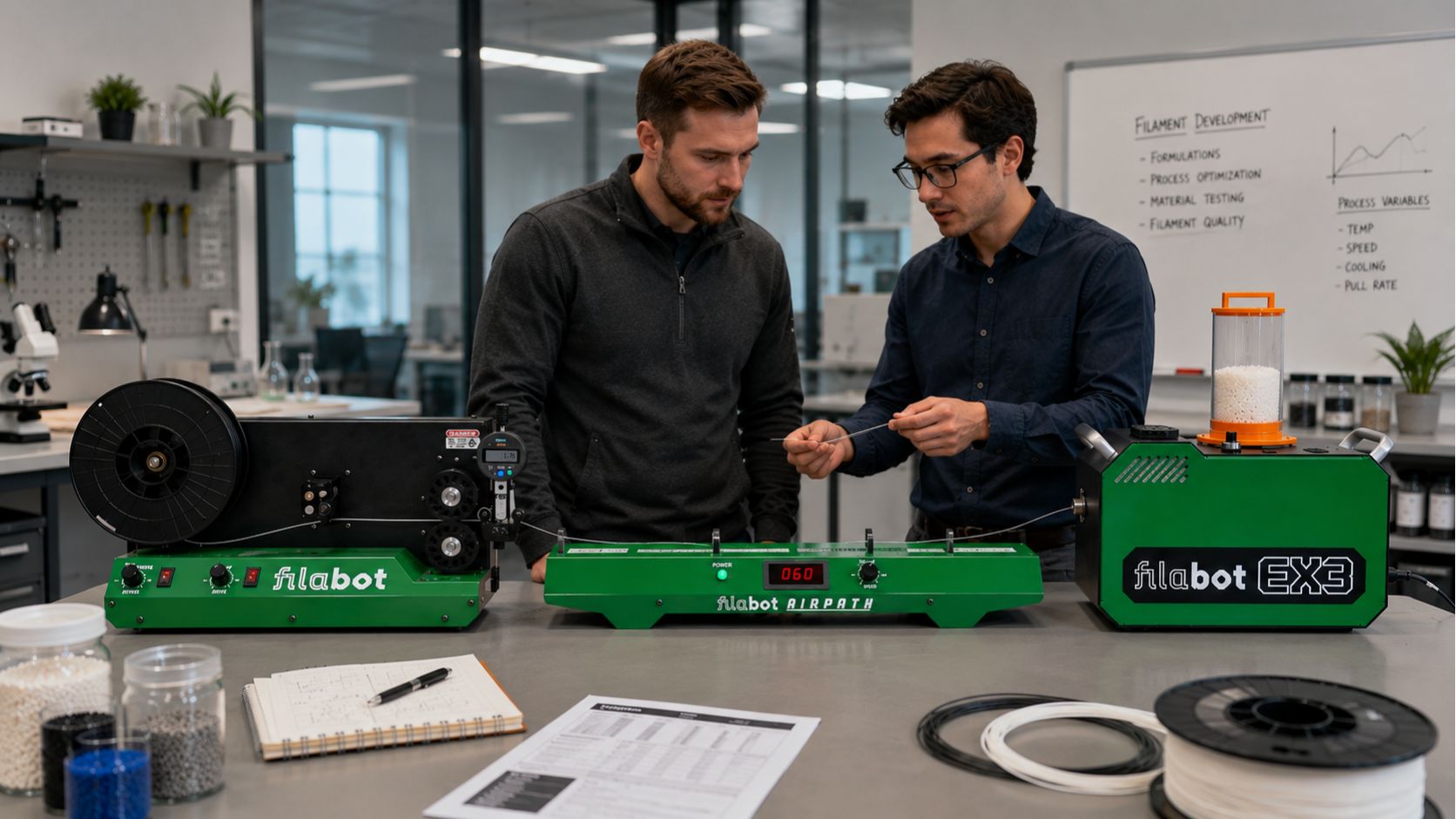
The Filabot EX3 was designed for people who don't just use materials, they develop them.
It gives educators, researchers, makers, and recyclers the confidence to process a broader range of materials, maintain exceptional consistency, and expand what's possible with filament extrusion.
Explore the EX3 and discover what's possible with the next generation of filament extrusion.
I agree to the processing of my data in accordance with the conditions set out in the Privacy Policy.
Filabot Recommendation Tool
Find Your Setup
Build Your Ideal Filabot System
Answer a few questions about your goals and materials — we'll recommend the right combination of equipment for your application.
Step 1 of 11Your Goal
Step 1 — Starting Point
What's your primary goal?
Select all that apply. This shapes your entire system configuration.
Recycling Waste Stream Plastics
Processing industrial or manufacturing plastic waste back into usable filament
Recycling Failed 3D Prints / Supports
Closing the loop on desktop or shop 3D printing waste
Custom Material Development
R&D, compounding, and experimenting with new filament formulations
Bulk Filament Production
Producing filament at volume for sale or internal use
Step 2 — Material
What plastic(s) are you working with?
Select all that apply. Yellow = difficult to process. Red = not safe to extrude on Filabot equipment.
PLA
ABS
PETG
Extended nozzle
PC
Nylon
PEEK
PEI
ULTEM
PP
HDPE
UHMW
LDPE
Difficult
LLDPE
Difficult
PET
Difficult
PETE
Difficult
TPE
Difficult
TPU
Difficult
HIPS
PS
WAX
PVC
Not safe
Co-polymers
Other / Custom
⚠ PVC Selected — PVC is not safe to extrude on Filabot systems. Please contact our team to discuss your application.
Step 3 — Feedstock
What form is your feedstock in?
The shape of your plastic before extrusion affects which upstream equipment is needed.
Pellets
Clean, uniform pellets ready for extrusion — the simplest feed path
Regrind
Material that has already been shredded into smaller granules
Flake
Flat flakes from an external source (e.g. water bottle flake) — requires careful tuning
Do you already have a shredder / reclaimer?
Yes — I have one
No — I need one
Note on Flake: Flake feedstock uses the same equipment as regrind but typically requires a longer tuning and process development period.
Step 4 — Reclaimer / Shredder
Do you need to shred plastic before extrusion?
We offer four reclaimers from benchtop to industrial scale.
No — my feedstock is already shredded or pelletized
Yes — I need to shred plastic parts or waste
Do you have 3-phase power available?
No — standard outlet only
110v or 220v single phase
Yes — 3-phase available
230 or 460 3-phase
What throughput do you need?
Up to 25 lbs/hr
Parts up to 10" cubed
Up to 250 lbs/hr
Up to 400 lbs/hr
Step 5 — Fillers & Additives
Are you adding any fillers or additives?
This directly affects which extruder is required.
No fillers or additives
Pure polymer extrusion
Abrasive Fillers
Carbon fiber, glass fiber, metal powders, or other abrasive materials
Non-Abrasive Fillers / Additives
Wood flour, hemp, UV stabilizers, colorants, or other non-abrasive additives
EX6 Industrial Required: Abrasive fillers require the hardened barrel of the EX6 Industrial to prevent premature wear.
Drying Required: Non-abrasive fillers and additives typically need to be dried before use — and it is strongly recommended that fillers are dried separately from the base polymer, as each may require different drying temperatures and times. A dedicated polymer dryer will be included in your recommendations.
Step 6 — Throughput / Volume
How much filament do you plan to produce?
This helps us match you to the right extruder for your production volume.
Low — up to ~1 kg/hr
Personal use, R&D, prototyping, or small batch production
Medium — 1–5 kg/hr
Makerspace, university lab, or small-scale production
High — 5+ kg/hr
Commercial or bulk filament production
Step 7 — Filament Diameter
What filament diameter are you targeting?
This determines nozzle sizing.
1.75mm
Most common for desktop FDM printers
2.85mm
Ultimaker and some industrial printers
3.00mm
Older standard, still used in some applications
Custom / Other
Non-standard diameter — we can help
Step 8 — Cooling
How do you want to cool the filament?
Air path is standard and works for most materials. A water bath can improve roundness and surface finish for certain polymers.
Air Path (Standard)
Included with the extruder — works for most materials, simplest setup. No additional equipment needed.
Water Bath
Better dimensional consistency for some polymers; requires more setup space
Would you like a recirculating pump to maintain water temperature?
Yes — temperature-controlled
More consistent results for engineering-grade materials
No — passive water bath
Step 9 — Spooling
How do you plan to spool your filament?
The Spooler and Spooler Max both include 1-axis mechanical diameter measurement standard.
Manual / I have my own
You'll handle spooling with existing equipment
Spooler — up to 2kg spools
Spooler Max — up to 10kg spools
For large format spools or high-volume production
Would you like to upgrade to 2-axis laser diameter measurement?
Yes — 2-axis laser
Detects oval filament a single-axis system would miss
No — standard 1-axis mechanical
Step 10 — Pelletizing
Do you need to turn your extrudate into pellets?
Useful for recycling workflows, injection molding prep, or FGF printing.
Recommended for recycling: For best results with recycled materials, we recommend extruding 100% recycled material first, pelletizing, then blending 50/50 by weight with virgin pellets before your final filament run. This significantly improves quality and consistency.
Yes — I need a pelletizer
No — I don't need one
Step 11 — Power Supply
What's your local power supply?
This determines your extruder configuration.
110v
North America standard
220v
Europe, UK, and most of the world
Step 12 — Fume Management
How is your workspace ventilated?
⚠ Chemical Hazard Warning: One or more of your selected materials may release harmful chemicals during extrusion, including styrene, acrylonitrile, BPA, ethylene glycol, or other compounds identified as health concerns. Dedicated fume management is highly recommended. (Seewoo et al., Heliyon, 2024)
Even with non-styrene materials, any polymer can produce harmful fumes if it undergoes thermal degradation. Good ventilation is always a best practice.
I have a dedicated ventilated space
Existing fume extraction or ventilation system in place
I need flexible / portable fume extraction
FumeX mobile fume duct — positioned where needed
I want a fully enclosed solution
Fume Hood — extruder lives inside for maximum containment
Skip fume management for now
Note: all polymers can release harmful fumes if thermally degraded during extrusion. We recommend addressing ventilation before operating.
Your Recommended System
Based on your inputs — here's what we'd recommend for your application.
Ready to talk it through?
Send us your recommendation and our team will follow up to confirm the configuration and help you get started.
Almost There
We'll email your full recommendation to our team and send a copy to you.
* Required fields. We'll never share your information with third parties.