

3D printing has transformed how universities, makerspaces, and R&D labs teach design, prototype ideas, and accelerate experimentation. A student can move from CAD model to physical part in hours. A research team can test a geometry before committing to tooling. A lab can support engineering, architecture, product design, robotics, and material science from the same additive manufacturing space.
But the growth of 3D printing has also exposed a weakness in how many labs operate: the material workflow is still largely linear.
Filament is purchased, printed, failed, purged, supported, discarded, and purchased again. Failed prints, support structures, purge strands, calibration waste, obsolete prototypes, and moisture-damaged filament all accumulate as a hidden cost of additive manufacturing. In academic makerspaces, where many operators are students and process discipline varies, print failure rates can be materially higher than in professional production settings. The prior Filabot white paper notes academic makerspace failure rates around 41% versus roughly 20% in more controlled professional environments, and cites a university FFF study where 34.6% of consumed thermoplastic feedstock became waste under realistic lab conditions.
That waste is usually treated as a sustainability problem. It is that — but it is also something more important.
It is a missed materials education opportunity.
The next generation of additive manufacturing labs will not be defined only by the number of printers they own. They will be defined by their ability to understand, control, modify, measure, and reuse materials. For universities and R&D labs, closed-loop polymer processing is not simply a way to reduce waste. Done correctly, it becomes a controlled materials innovation platform.

Recycling Is Not Enough
The word “recycling” can make the process sound simple: collect failed prints, grind them, melt them, and turn them back into filament. In reality, that approach often fails.
A failed print is not automatically usable feedstock. It may be the wrong polymer. It may contain support material, adhesives, paper labels, oils, dust, or unknown contaminants. It may have absorbed moisture. It may have been overheated during printing. It may be mixed with incompatible resins. If that material is simply shredded and pushed through an extruder, the result can be brittle filament, inconsistent diameter, poor melt flow, bubbles, weak printed parts, clogged nozzles, and frustrated users.
That is why the real shift is not from “waste” to “recycled filament.” The real shift is from uncontrolled material consumption to controlled polymer processing.
A serious closed-loop lab treats every step as part of a material system: sorting, cleaning, drying, granulating, blending, compounding, extruding, filtering, cooling, measuring, and spooling. Each step affects the next. Each variable matters. Each failure mode teaches something about polymer behavior.
This is where universities and R&D labs have a unique advantage. They are not just trying to make cheaper filament. They are trying to teach better engineering, run better experiments, and build deeper material understanding.
The Six Controls of Reliable Closed-Loop Filament Production
A controlled materials innovation platform starts with process discipline. The equipment matters, but equipment alone does not create a closed loop. The workflow does.
1. Material identification and segregation
Different polymers do not behave the same way. PLA, PETG, ABS, HDPE, PP, and other materials have different melting temperatures, viscosities, shrinkage behavior, moisture sensitivity, and emissions profiles. Mixing incompatible polymers can cause phase separation, inconsistent melt behavior, weak filament, nozzle blockage, and unreliable print results. A closed-loop lab needs clear sorting protocols, labeled bins, and rules that prevent unknown or unsafe plastics from entering the workflow. The prior white paper specifically warns against processing PVC because of the risk of toxic and corrosive gas release during heating.
2. Cleaning and drying
Moisture is one of the most underestimated causes of poor filament quality. Hygroscopic polymers absorb water from the air, and that moisture can flash into vapor during extrusion. The result is bubbles, voids, inconsistent strand formation, and weak final material. Surface contamination creates another problem: dust, adhesives, grease, and labels can become clog points or stress concentrators. A proper workflow treats cleaning and drying as required process steps, not optional preparation.
3. Controlled granulation
The size and consistency of regrind matter. Oversized or irregular particles can bridge in the hopper, starve the screw, and cause inconsistent flow. Fine dust can behave differently than clean granulate. Consistent particle size improves feeding behavior and helps stabilize the extrusion process. In a teaching lab, this is a valuable lesson: material preparation is part of manufacturing, not a side activity.
4. Blending and compounding
Recycled polymers have already experienced at least one thermal cycle. That can reduce molecular weight, lower melt strength, and make the material more brittle. In many cases, blending recycled material with virgin pellets improves process stability and final filament quality. The earlier white paper recommends a 50/50 recycled-to-virgin blending strategy as a practical starting point for maintaining reliable print performance.
For R&D labs, this step opens the door to more than recycling. It enables compounding. Researchers and students can explore additives, fillers, pigments, natural fibers, conductive materials, magnetic particles, or other experimental formulations. The waste stream becomes a base material for discovery.
5. Extrusion, screw design, and melt control
The extruder is the heart of the system. Reliable filament depends on stable screw speed, sufficient torque, appropriate temperature control, consistent melt pressure, and screw geometry suited to the material. A simple low-power system may be able to melt easy virgin polymers, but it can struggle with recycled flakes, filled compounds, viscous materials, or inconsistent feedstock.
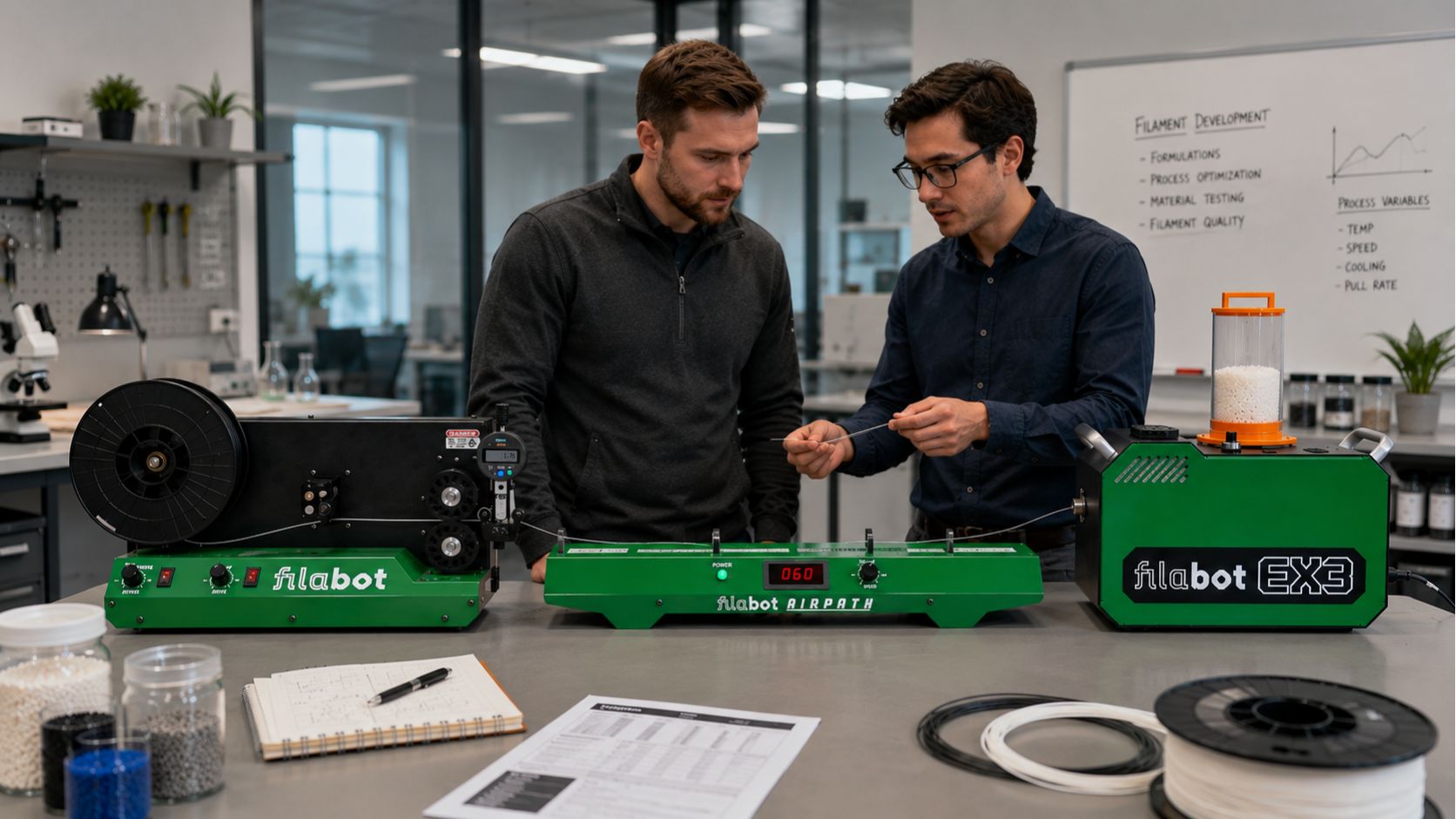
This is where lab-scale extrusion must be treated seriously. Screw length-to-diameter ratio, compression profile, torque delivery, removable screws, nozzle options, and filtration all influence whether the output is a usable filament or an experiment that fails downstream. The prior white paper highlights the importance of L/D ratio, feed/transition/metering zones, progressive compression, torque stability, and melt filtration for producing consistent filament. It also notes Filabot EX3 and EX6 characteristics such as removable screws, 14:1 and 24:1 L/D configurations, high-temperature capability, and torque-focused design.
6. Cooling, measurement, pull speed, and spooling
Filament quality is not finished when the melt exits the nozzle. That is only the beginning of strand formation. The molten polymer must be cooled at the right rate, pulled under controlled tension, measured, and spooled without introducing ovality, stretching, or diameter swings.
Cool too fast, and the strand may develop internal stress or warping. Cool too slowly, and the filament can sag, deform, or become inconsistent. Pull too fast, and the diameter drops. Pull too slowly, and the diameter grows. This is why a complete workflow needs cooling, controlled pull speed, diameter measurement, and disciplined spooling. The previous white paper emphasizes the role of air or water cooling, speed-controlled spooling, and real-time diameter measurement in maintaining dimensional consistency.
From Waste Stream to Research Platform
The most forward-looking universities are not stopping at “we recycled our failed prints.” They are using closed-loop extrusion to create hands-on polymer learning environments.
At Harvard, discarded thermoplastic parts from student robotics coursework became the basis for an on-site filament recycling station using Filabot equipment. Students and staff developed a process to collect, grind, and re-extrude PLA waste into filament suitable for reuse, while also learning how temperature windows and puller speeds affect diameter variance.
At the University of Utah, students used desktop extrusion to go beyond basic recycling. They processed recycled PETG and compounded it with additives such as color pigments, coffee grounds, wood ash, iron filings, magnetic filings, and temperature-sensitive color-changing compounds. The work connected additive manufacturing with material formulation, rheology, mechanical behavior, and design exploration.
These examples show the larger opportunity. A closed-loop extrusion lab can support sustainability goals, but it can also support curriculum development, grant proposals, advanced design studios, materials research, and interdisciplinary collaboration.
For engineering students, it teaches process control.
For design students, it expands material creativity.
For sustainability teams, it creates a visible circular economy initiative.
For researchers, it enables custom feedstock development.
For lab managers, it reduces dependence on external filament supply and gives them more control over material use.
What a Serious Lab-Scale Platform Needs
Not every filament extruder is suited for this role. Universities and R&D labs should look beyond the basic question of whether a machine can make filament. The better question is whether the platform can support repeatable, measurable, and teachable material control.
A credible lab-scale extrusion platform should offer:
-
Sufficient torque to maintain screw speed under changing material loads
-
Screw geometry designed for melting, mixing, compression, and metering
-
Interchangeable screws for different materials and research needs
-
Temperature capability for both common and advanced polymers
-
Cooling options matched to material and throughput
-
Controlled pulling and spooling
-
Diameter measurement and process feedback
-
Melt filtration options for recycled or contaminated feedstock
-
Safety and fume-management compatibility
-
A modular workflow that can grow with the lab
This is where Filabot should lead the conversation. Filabot is not just selling an extruder. The stronger position is that Filabot enables the full material loop: prepare, process, measure, spool, test, print, and reuse. That matters because labs do not need another black-box machine. They need a platform that makes the polymer lifecycle visible, adjustable, and teachable.
Building the Closed-Loop Lab
A practical implementation does not need to begin with every material or every possible workflow. In fact, the best programs usually start narrower.
A university lab might begin with clean PLA or PETG from known printers, sorted into clearly labeled bins. Staff can define what is acceptable feedstock and what must be rejected. Materials can be cleaned, dried, granulated, and blended with virgin pellets. The extrusion system can then be used to establish baseline settings for temperature, screw speed, cooling, pull speed, and diameter consistency.
Once the baseline is stable, the lab can expand. Students can test recycled-content ratios. Researchers can introduce additives. Makerspaces can compare mechanical properties between virgin and recycled blends. Sustainability offices can track material diversion. Engineering departments can connect the workflow to coursework in materials science, manufacturing, circular economy, and design for sustainability.
The key is to treat the lab as a system, not a machine purchase.
That system includes equipment, material rules, safety procedures, documentation, training, and measurement. It also includes the willingness to accept that recycled filament is not magic. It is manufacturing. Good results come from good process control.
The Future: Material Literacy as a Core Additive Manufacturing Skill
For years, the center of additive manufacturing education has been the printer. Students learned slicing, supports, bed adhesion, print settings, and part design. Those skills remain important, but they are no longer enough.
The next phase is material literacy.
Students and researchers need to understand how polymer type, moisture, contamination, melt viscosity, screw design, residence time, cooling rate, and filament diameter affect final print performance. They need to see that material is not a consumable commodity. It is an engineered input.
That is the real promise of closed-loop polymer processing. It turns waste into feedstock, but more importantly, it turns feedstock into knowledge.
For universities, that means a stronger link between sustainability and engineering education. For R&D labs, it means faster experimentation with custom materials. For makerspaces, it means less waste and more control. For students, it means learning the full manufacturing loop — not just how to print a part, but how to understand the material that makes the part possible.
Recycling is the entry point. Materials innovation is the destination.
And for labs ready to move beyond the linear model of buy, print, discard, and repeat, the opportunity is clear: build the material loop, control the process, and turn every failed print into the beginning of the next experiment.